Venus Pool - 11 Feb 18

Here are a few images from my visit to Venus pool this afternoon.

A fine pair of Mallard. These foraging for food dropped at the feeders in the woodland hide at the SOS Reserve at Venus Pool.
A trio of Chaffinches seem unconcerned about the Mallard. We see the curly tail on the drake Mallard – a very strong gene that is present in most drake hybrids.
What exactly is the evolutionary path that produces the extraordinary plumage on this male Pheasant?

The feeders were alive with tits of course. Here is, obviously, a Blue Tit. Apparently the eyes of Blue Tits ‘see’ their blue the same way as we see the blue of Kingfisher. Looks quite vivid to me anyway.
And an always engaging Long-tailed Tit.

A female Chaffinch is actually quite attractive if understated.

Rather shy today and the lone example we found was this female Brambling. Although a male would not have the full black head of a breeding adult yet it would show a vertical black area between the bill and the eye. There would also be some yellow on the bill.

Also eating the food dropped from the feeders was this vole sp. But which? One possibility is Short Tailed Field Vole, but that begs the question of how ‘short’ is ‘short’...?
The strong rufous colouring, especially on the neck, and the relatively large ears means this is a Bank Vole.

The rufous tone is well illustrated here.

Once finished with the woodland hide we went in to the (expanded) main hide where there was a fine array of ducks and drakes to get to grips with. Here is a drake Common Shelduck – he has the larger swelling at the base of the bill.
He was also part of the synchronised drowning competition – he is on the left with the brighter undertail.

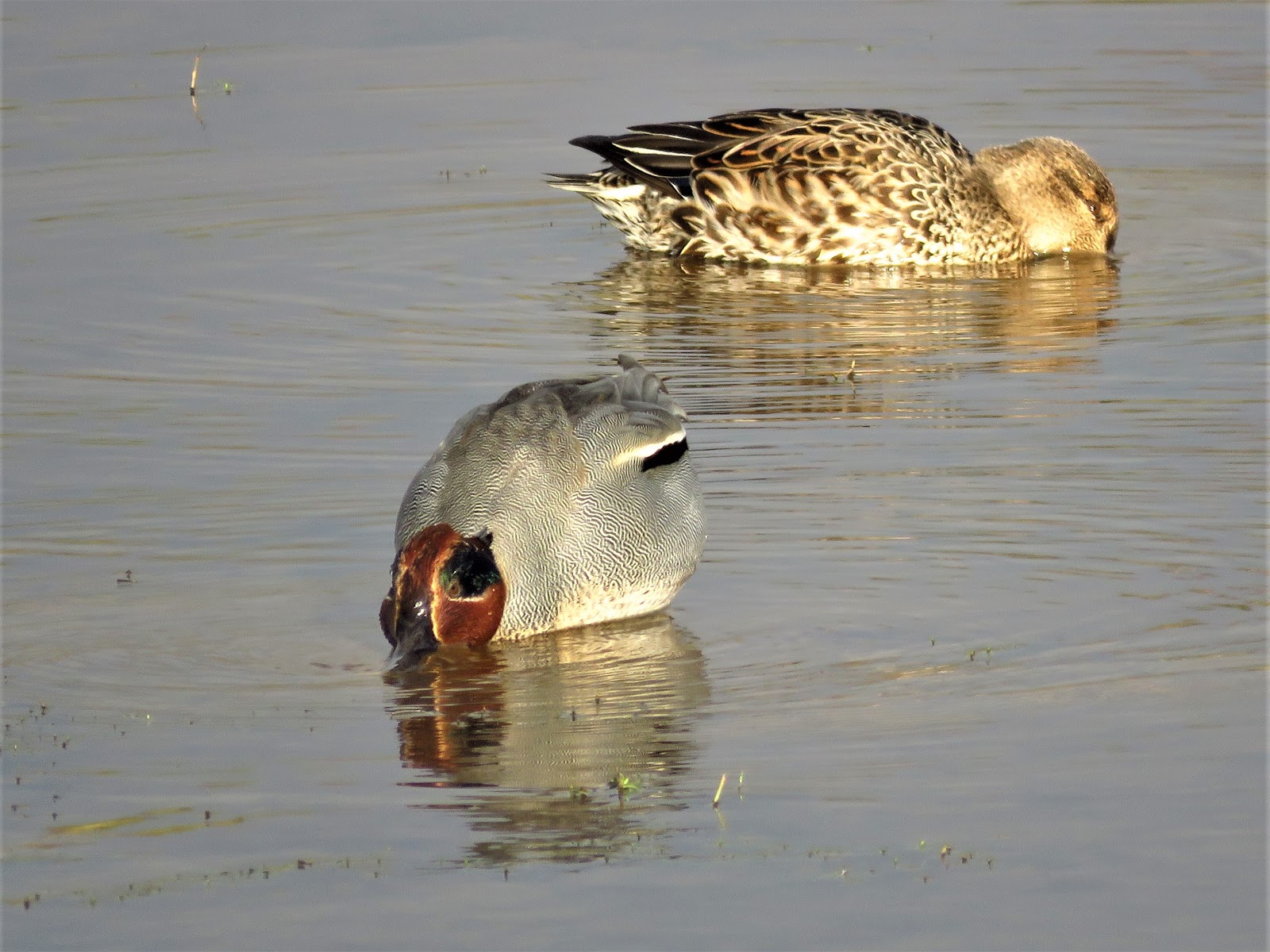
A fine drake (Common) Teal in great light. Note particular the long scapulars hanging across the back.

And a pair of (Common) Teal. Note the short pale horizontal stripe under the duck’s tail. This can be used to identify ducks of this species from all other small brown ducks even at long range.

Here, at the back, we see a fine drake Pintail, though rather distant and not as crisp as I would have liked. We see the long ‘pin’ tail and the distinctive neck white stripe on the otherwise chocolate head and neck. Over-exposed pair of Shoveler in the foreground.

Another view. The black bill is very obvious. A duck Shoveler again in the foreground: this a typical view of this species which seems to spend its entire time with its distinctive bill hidden as it sifts food from the water.

A rather better shot of a pair of Shoveler with the drake keeping a careful eye on me.

There were a number of very busy Common Snipe running around and feeding – hence hard to ‘freeze’ the action. Note the rufous tail-feathers. It is now thought that birds with ‘brighter’ tail feathers are in better condition. The result is that these feather, held open to vibrate in the air when the bird does its diving display flight, make more noise as they are also stronger. This indicates a ‘better’ mate to the females on the ground.

(Ed Wilson)

Aqualate Mere - 8 Feb 18

Here are a few images from Aqualate Mere today:

The public hide at Aqualate Mere just across the border enables close views of some water birds. What on earth is going on here...?
Oh: a Mute Swan cygnet having a bath. Note the beginning a swelling at the base of the bill as it matures.
Seems to be enjoying the experience.

This Grey Heron caught this large Pike in the reeds. The Grey Heron had to move to get settled-enough to eat it
Sadly it disappeared behind reeds to get the fish aligned so it could swallow it. Through the reeds we can see the fish’s head is already down the throat
Now the gills have got to be swallowed

Look: all gone – well just a tail-fin sticking out

A pair of (Eurasian) Wigeon. The duck in front shows the distinctive head shape and white belly. The drake shows the white upper-wing markings
From the hide birds come to the feeder. Photos of birds on feeders are none too attractive. With a bit of patience they can be photographed in a more natural environment as they approach or leave the area. We do not often study the pattern on the back of Blue Tits. Here we can
Now we see why most photos show the front: what a sweetie!

And a Great Tit waits its turn

A male Reed Bunting coming in to plumage: the brown and grey areas on the face will soon go jet-black. This bird, like a female I photographed at Priorslee Lake a week ago, has been ringed.

(Ed Wilson)

Venus Pool and Shawbury - 29 Jan 18

Later today I went to Venus Pool and then onto Shawbury.

Venus Pool

A visit to the SOS reserve at Venus Pool was not entirely successful. I had forgotten that some of the hides would be closed to allow them to be extended. The necessary work had clearly disturbed the birds and there were very few present on the water. I went to the more or less undisturbed woodland hide where, with the rain clouds not entirely cleared it was rather dull, making photography difficult. However ... I persevered. Female ducks are really attractive when seen well: here a duck Mallard of course.

I know they are not truly wild, being supplemented by birds put down expressly for shooting. Male Pheasants are nevertheless very handsome birds.

How could I resist another shot? And how could anyone shoot such a magnificent bird.

Ready for another view?

Moorhens are quite colourful when seen in close-up.

Out in the open there were more than 500 Lapwings swirling around, mostly high up or in the distance. This small group came closer.

A female Great Spotted Woodpecker – no red on the nape (the rather strange cast obvious on the nape is a very out-of-focus twig in the foreground).
Another view (the out-of-focus twig is almost vertical through the bird’s body).

Always a challenge to get Long-tailed Tits to stay still long-enough to get a sharp shot – especially in the rather gloomy conditions.
A different view.

A male Chaffinch. Lots of colours in its very complex plumage. Note the feet show signs of ‘scaly leg’ – caused by mites. Apparently the birds are in discomfort but it does not make them unwell (how do ‘they’ know?).

Against the light I was unsure what species this was – Linnet or Lesser Redpoll. A record shot and a bit of editing and we see the red ‘poll’ and the small black ‘moustache’ under the small pointed yellow bill. So Lesser Redpoll it is.
Typically the sun came out as I was leaving: a Reed Bunting. Not in full plumage the dark cheeks are sufficient to identify it as a male. In this plumage it is very similar to the rare Rustic Bunting – there was one here last winter. However Rustic Bunting would show a pink bill.

Shawbury

Later I went to Shawbury to watch the helicopters and was distracted by this Kestrel. When you look at illustrations in field guides separation of male and female looks easy. It often isn’t and the only ‘clincher’ for me here is the barring on the edge of the outer tail-feather – so it is a female.
This view we see the whole barred undertail confirming it is a female. A male’s undertail is plain grey with a black tip.

(Ed Wilson)

Burton Mere RSPB Reserve - 20 Jan 18

Today I visited the RSPB Reserve at Burton Mere on the Wirral. Continuous slight rain and low cloud made for poor visibility an some less than inspiring pictures. The best of the bunch included this fly-by of three Whooper Swans. They typically show more yellow on the base of the bill than the other species of ‘wild’ swan that visits the UK – the Bewick’s (or Tundra) Swan. Not easy to tell at this range and in these conditions. However Bewick’s Swans are significantly smaller than other swans at that would have been obvious.

This fine drake Teal came close-enough to provide some colour.

Certainly a place to see egrets: here a Little Egret showing plenty of breeding condition ‘aigrettes’ hanging from the breast and over the tail. The blue-grey lores (above the base of the bill) will change to orange when breeding starts.

A different bird: ‘aigrettes’ only showing on the back of this bird.

A Grey Heron standing sentry.

Other than flocks of Lapwing the commonest wader here at this time of year is Black-tailed Godwit. In the foreground a first-winter bird with pale fringes to its feathers. Behind an adult – they can, as here, look surprisingly grey.

A group of juveniles. The bird in the right foreground is showing its ‘black tail’ and white rump.

A single juvenile feeding.

Moments later it opens its bill. I am always surprised to see that waders can open their bill mostly just at the end. It is essential that species feeding by probing can do this – they need to able to grab food detected deep underground.

The only other wader I managed to catch on camera (apart from the Lapwings) was this distant Dunlin. Easy to identify by its dark belly patch in the breeding season: less so at this date. The size and the proportionately long and slightly decurved bill are the best clues.

Later I moved to Parkgate, which overlooks the salt marshes along the Dee Estuary. High tide is best, though today was a neap tide and birds were still too far away. This first-winter Great Black-backed Gull made a fly-by. Can be identified by size and lumbering flight. In the photo we see the large all-dark bill and relatively unmarked head. Another ID feature is that the dark trailing edge to the wing ‘disappears’ on the inner primaries. This would not happen on a Lesser Black-backed Gull which would also show two rows of dark feathers on the trailing edge of the wing – the greater coverts as well as the secondaries. A Herring Gull would have noticeably paler outer parts to the inner primaries – called the ‘window’.

Good to see were the typically chaotic flocks of Lapwing. Have you ever tried counting a flock? They are forever changing formation and direction.

Here we go: back again.

Perhaps we were right first time.

Best sighting was a VERY distant Marsh Harrier. We see (against a rather industrial landscape) a very typical silhouette as it hunts over the reeds. We can just about make out the pale head on this bird.

A rather scruffy bird moulting its tail-feathers. Some pale in the primary coverts from below perhaps suggests an immature male, but at this range and light conditions it is not possible to be certain.

Even more distant! The bird was joined by another and they sparred for a while. It may be my imagination but the bird on the right seems to be carrying prey. During courtship the males of most birds of prey will present prey items to their intended partners and pass it to them on the wing to show they will be capable of providing food for the brooding female and eventual off-spring (a bit like buying/preparing your girlfriend a meal and exchanging forkfuls of food?)

(Ed Wilson)

Mute Swans at Priorslee Lake - 2017

Here is a montage I have put together of the Mute Swan cygnets at Priorslee Lake this year. (Mark Williams)