Today I made a visit to the Prees Heath Common Reserve. This SSSI is just south of Warrington.
Thanks to the efforts of Butterfly Conservation and Cheshire and Shropshire Wildlife Trusts it is now being restored and managed as the last refuge of the Silver-studded Blue butterfly (Plebejus argus) in the West Midlands. My visit was probably rather late in the season for this species. Two flighty ‘blues’ could well have easily been Common Blues (Polyommatus icarus). Nevertheless there was an impressive array of butterflies to be found during a short visit.
The list was:
Essex Skipper (Thymelicus lineola)
Small Skipper (Thymelicus sylvestris)
Large Skipper (Ochlodes sylvanus)
Large White (Pieris brassicae)
Green-veined White (Pieris napi)
Brimstone (Gonepteryx rhamni)
*Small Heath (Coenonympha pamphilus)
Meadow Brown (Maniola jurtina)
Gatekeeper (Pyronia tithonus)
Painted Lady (Vanessa cardui)
Peacock (Aglais io)
Small Tortoiseshell (Aglais urticae)
*Small Copper (Lycaena phlaeas)
**Purple Hairstreak (Neozephyrus quercus)
* = new for me in 2019
** = new for me in Shropshire
Here are some images I took during the visit.
Here I am looking more or less north. It is hard to credit that the junction of the A41 and A49 is less than a mile away.
Another view with a prominent Common Ragwort (Jacobaea vulgaris) plant in the foreground.
This Meadow Brown (Maniola jurtina) seems to have been in the wars with rather battered wings.
With two white spots in the forewing black circle this butterfly is a Gatekeeper (
Pyronia tithonus). This is a male with a dark smudge extending up the middle of the wing.
Not always easy to get any scale to photographs. This butterfly was significantly smaller than the Meadow Brown and as it only has one white spot in the black circle it is not a Gatekeeper. It is a Small Heath (
Coenonympha pamphilus) and we can confirm that from the very jagged black outline on the underside of the hind wing.
This is a Small Copper (Lycaena phlaeas).
Here the underside of an individual feeding on ragwort – a very important food plant for all manner of insects.
A closer view of the underside.
This one lurking on the ground.
There is a reported big influx of Painted Lady butterflies (
Vanessa cardui) this year (though I am seeing many more Peacocks (
Aglais io)). This Painted Lady is enjoying the Bell Heather (
Erica cinerea).
Its tongue it hooked right back, deep in the heather flower.
Like many of the Vanessid butterflies when the wings are closed identification can be tricky. This specimen is holding its forewing partially raised allowing a glimpse of the true pattern.
For me this was the star sighting of the day. It is a male Purple Hairstreak (
Neozephyrus quercus). The short ‘tail’ on the hind wing of hairstreak butterflies is not easy to see and often breaks off. We can just see the rather ragged-looking edge to the wing. There is a hint of purple in the centre of the forewing.
A closer view. This was a very lucky sighting. This species normally feeds on aphid dew in the very tops of oak trees – indeed there was a photographer present with a BIG lens on a mission to photo this species at the top of a relatively small oak sapling. He was somewhat miffed to see that I had found one taking a snack on ragwort.
Thistles are another popular nectar source. Not enough in the shot to identify which thistle species is getting attention from a Six-spot Burnet moth (
Zygaena filipendulae).
This burnet is enjoying its meal.
While a lucky thistle has two burnets feeding.
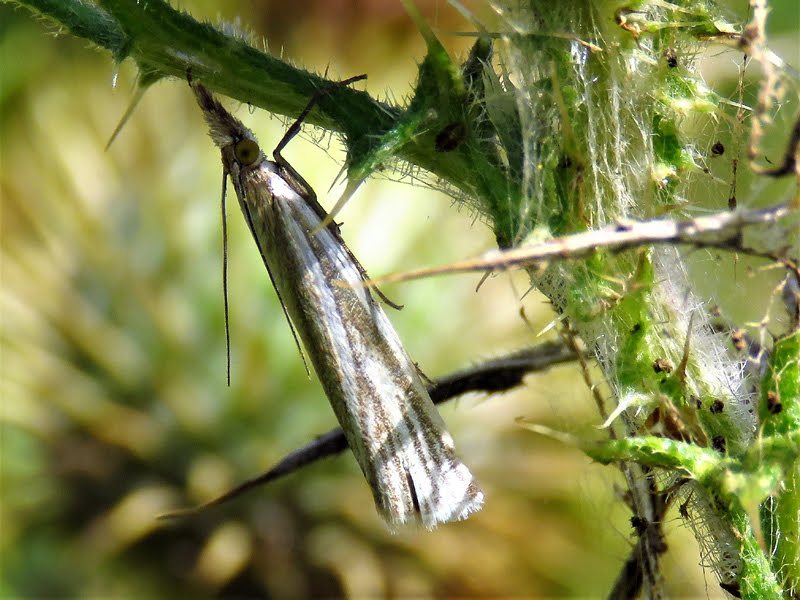
Can’t get away from grass moths. They were not too well-behaved and I struggled to get any to pose at a good angle and in good light. The rather diffuse dark markings on this specimen point to it being Barred Grass-veneer (
Agriphila inquinatella). The apparent angled mark on the wing-tip is a shadow. This species prefers dry areas – heath is perfect.
A different species with two diagonal lines across the wing – an Elbow-stripe Grass-veneer (
Agriphila geniculea). Here temporarily tangled up in a web. It escaped.
And another – this shows rather weak markings but with a tell-tale line at the wing-edge. That makes it a Straw Grass-veneer (
Agriphila straminella). It is quite usual for many species of grass-moth to occur together.
While this is an ‘old friend’ from the lake – a Garden Grass-veneer (Chrysoteuchia culmella).
Hoverflies were also enjoying the ragwort. This is a Common Drone-fly (Eristalis tenax).
With a rather elongated look to the body this is a Tapered Drone-fly (Eristalis pertinax) tucking in.
Not just hoverflies. This is likely a fly in the genus
Phaonia. There are many to choose from, not easy to separate.
A White-tailed Bumblebees (Bombus lucorum) also on a thistle.
These two insects seem most likely to be Sand Tailed Digger Wasps (
Cerceris arenaria). This species is a very common inhabitant of heathland.
Among the other things I found was this ‘beetle’. It was tiny – the background is a small part of my palm. I am inclined to think this is an instar of a shield bug. The markings on its wing-edge and more especially the short horizontal marks on the back all look similar to the marking on instar Common Green Shield Bug, though this is rather different in both ground-colour and shape.
Another tiny insect that I am more confident about even though I cannot recall seeing one before. It is a 16 Spot Ladybird (
Tytthaspis sedecimpunctata)
This plant was abundant amongst the heathers. Not being a botanist it took me some while to track down it identity. It is Common Centaury (
Centaurium erythraea). It likes well-drained soil.
(Ed Wilson)